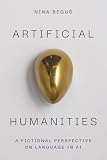
Artificial Humanities : a fictional perspective on language in AI / Nina Beguš.
By: Beguš, Nina [author,]
Contributor(s): Michigan Publishing (University of Michigan) [publisher.]
Language: English Publisher: Ann Arbor : University of Michigan Press, 2025Copyright date: ©2025Description: 1 online resource (283 pages) : illustrations, chartsContent type: text Media type: computer Carrier type: online resourceISBN: 9780472077731; 9780472905324; 0472905325Other title: Fictional perspective on language in AISubject(s): Artificial intelligence -- Philosophy | Artificial intelligence -- History | Digital humanities | Artificial intelligence in literatureGenre/Form: Electronic books.DDC classification: LOC classification: Q334.7Online resources: Electronic books. Abstract: Artificial Humanities explores how the humanities--literature, history, and art--can deepen our understanding of artificial intelligence and its development. By examining fictional representations of AI in parallel with actual technological developments, Nina Beguš presents a novel interdisciplinary framework for understanding the cultural, philosophical, and ethical dimensions of AI. She traces connections from Eliza Doolittle to ELIZA the chatbot and current language models, incorporates Slavic fictional examples from the Pygmalion paradigm, and compares mid-century science fiction and recent Hollywood films with contemporary developments in social robotics and virtual beings. Highlighting the impact of human-like AI design, from gendered virtual assistants to romanticized social robots, the book shows how these technologies intersect with longstanding humanistic questions about the concepts of creativity and language as well as the relations between humans and machines. Additionally, the book explores AI's applications in medical fields, particularly psychiatry and neurotechnology, including how AI interacts with the human body and mind to address conditions like paralysis. By emphasizing the philosophical and cultural implications of these technologies, Beguš highlights the need for responsible innovation that prioritizes human well-being as well as machine potential outside of human imitation. Accessible and thought-provoking, Artificial Humanities offers tools for analyzing and assessing technologies while they are being developed and invites readers to see how the humanities can guide us toward a more thoughtful future for AI.| Item type | Current location | Home library | Call number | Status | Date due | Barcode | Item holds |
|---|---|---|---|---|---|---|---|
 EBOOK
EBOOK
|
COLLEGE LIBRARY | COLLEGE LIBRARY | Available |
Includes bibliographical references (pages 221-283).
Artificial Humanities explores how the humanities--literature, history, and art--can deepen our understanding of artificial intelligence and its development. By examining fictional representations of AI in parallel with actual technological developments, Nina Beguš presents a novel interdisciplinary framework for understanding the cultural, philosophical, and ethical dimensions of AI. She traces connections from Eliza Doolittle to ELIZA the chatbot and current language models, incorporates Slavic fictional examples from the Pygmalion paradigm, and compares mid-century science fiction and recent Hollywood films with contemporary developments in social robotics and virtual beings. Highlighting the impact of human-like AI design, from gendered virtual assistants to romanticized social robots, the book shows how these technologies intersect with longstanding humanistic questions about the concepts of creativity and language as well as the relations between humans and machines. Additionally, the book explores AI's applications in medical fields, particularly psychiatry and neurotechnology, including how AI interacts with the human body and mind to address conditions like paralysis. By emphasizing the philosophical and cultural implications of these technologies, Beguš highlights the need for responsible innovation that prioritizes human well-being as well as machine potential outside of human imitation. Accessible and thought-provoking, Artificial Humanities offers tools for analyzing and assessing technologies while they are being developed and invites readers to see how the humanities can guide us toward a more thoughtful future for AI.
This work is licensed under Creative Commons Attribution-NonCommercial 4.0 International License.
https://creativecommons.org/licenses/by-nc/4.0/
Description based on information from the publisher.
There are no comments for this item.