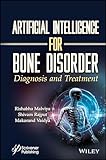
Artificial intelligence for bone disorder : diagnosis and treatment / Rishabha Malviya, Shivam Rajput and Makarand Vaidya.
By: Malviya, Rishabha [author.]
Contributor(s): Rajput, Shivam [author.] | Vaidya, Makarand [author.]
Language: English Publisher: Hoboken, NJ : Beverly, MA : Wiley ; Scrivener Publishing, 2024Description: 1 online resource (272 pages)Content type: text Media type: computer Carrier type: online resourceISBN: 9781394230884; 9781394230914; 1394230915; 9781394230891; 1394230893; 9781394230907; 1394230907Subject(s): Bones -- Diseases -- Data processing | Artificial intelligence -- Medical applicationsGenre/Form: Electronic books.DDC classification: 616.7/1028563 LOC classification: RC930Online resources: Full text is available at Wiley Online Library. Click here to view.| Item type | Current location | Home library | Call number | Status | Date due | Barcode | Item holds |
|---|---|---|---|---|---|---|---|
 EBOOK
EBOOK
|
COLLEGE LIBRARY | COLLEGE LIBRARY | 616.71028563 M2996 2024 (Browse shelf) | Available (In Process) |
Includes bibliographical references and index.
Foreword -- Preface -- 1 Artificial Intelligence and Bone Fracture Detection: An Unexpected Alliance -- 1.1 Introduction -- 1.2 Bone Fracture -- 1.3 Deep Learning and Its Significance in Radiology -- 1.4 Role of AI in Bone Fracture Detection and Its Application -- 1.5 Primary Machine Learning-Based Algorithm in Bone Fracture Detection -- 1.6 Deep Learning-Based Techniques for Fracture Detection -- 1.7 Conclusion -- 2 Integrating AI With Tissue Engineering: The Next Step in Bone Regeneration -- 2.1 Introduction -- 2.2 Anatomy and Biology of Bone -- 2.3 Bone Regeneration Mechanism -- 2.4 Understanding AI -- 2.5 Current AI Integration -- 2.6 Applying Deep Learning -- 2.7 Conclusion -- 3 Deep Supervised Learning on Radiological Images to Classify Bone Fractures: A Novel Approach -- 3.1 Introduction -- 3.2 Common Bone Disorder -- 3.3 Deep Supervised Learning's Importance in Orthopedics and Radiology -- 3.4 Perspective From the Past -- 3.5 Essential Deep Learning Methods for Bone Imaging -- 3.6 Strategies for Effective Annotation -- 3.7 Application of Deep Learning to the Detection of Fractures -- 3.8 Conclusion -- 4 Treatment of Osteoporosis and the Use of Digital Health Intervention -- 4.1 Introduction -- 4.2 Opportunistic Diagnosis of Osteoporosis -- 4.3 Predictive Models -- 4.4 Assessment of Fracture Risk and Osteoporosis Diagnosis by Digital Health -- 4.5 Clinical Decision Support Tools, Reminders, and Prompts for Spotting Osteoporosis in Digital Health Settings -- 4.6 The Role of Digital Health in Facilitating Patient Education, Decision, and Conversation -- 4.7 Conclusion -- 5 Utilizing AI to Improve Orthopedic Care -- 5.1 Introduction -- 5.2 What is AI? -- 5.3 Introduction to Machine Learning: Algorithms and Applications -- 5.4 Natural Language Processing -- 5.5 The Internet of Things -- 5.6 Prospective AI Advantages in Orthopedics -- 5.7 Diagnostic Application of AI -- 5.8 Prediction Application With AI -- 5.9 Conclusion -- 6 Significance of Artificial Intelligence in Spinal Disorder Treatment -- 6.1 Introduction -- 6.2 Machine Learning -- 6.3 Methods Derived From Statistics -- 6.4 Applications of Machine Learning in Spine Surgery -- 6.5 Application of AI and ML in Spine Research -- 6.6 Conclusion -- 7 Osteoporosis Biomarker Identification and Use of Machine Learning in Osteoporosis Treatment -- 7.1 Introduction -- 7.2 Biomarkers of Bone Development -- 7.3 Biomarkers for Bone Resorption -- 7.4 Regulators of Bone Turnover -- 7.5 Methods to Identify Osteoporosis -- 7.6 Conclusion -- 8 The Role of AI in Pediatric Orthopedics -- 8.1 Introduction -- 8.2 Strategy Based on Artificial Intelligence -- 8.3 Several Applications of Artificial Intelligence -- 8.4 Conclusion -- 9 Use of Artificial Intelligence in Imaging for Bone Cancer -- 9.1 Introduction -- 9.2 Applications of Machine Learning to Cancer Diagnosis -- 9.3 Artificial Intelligence Methods for Diagnosing Bone Cancer -- 9.4 Methodologies for Constructing Deep Learning Model -- 9.5 Clinical Image Applications of Deep Learning for Bone Tumors -- 9.6 Conclusion -- References -- Index.
ARTIFICIAL INTELLIGENCE FOR BONE DISORDER The authors have produced an invaluable resource that connects the fields of AI and bone treatment by providing essential insights into the current state and future of AI in bone condition diagnosis and therapy, as well as a methodical examination of machine learning algorithms, deep learning approaches, and their real-world uses. The book explores the use of artificial intelligence (AI) in the diagnosis and treatment of various bone illnesses. The integration of AI approaches in the fields of orthopedics, radiography, tissue engineering, and other areas related to bone are discussed in detail. It covers tissue engineering methods for bone regeneration and investigates the use of AI tools in this area, emphasizing the value of deep learning and how to use AI in tissue engineering efficiently. The book also covers diagnostic and prognostic uses of AI in orthopedics, such as the diagnosis of disorders involving the hip and knee as well as prognoses for therapies. Chapters also look at MRI, trabecular biomechanical strength, and other methods for diagnosing osteoporosis. Other issues the book examines include several uses of AI in pediatric orthopedics, 3D modeling, digital X-ray radiogrammetry, convolutional neural networks for customized care, and digital tomography. With information on the most recent developments and potential future applications, each chapter of the book advances our understanding of how AI might be used to diagnose and treat bone problems. Audience This book will serve as a guide for orthopedic experts, biomedical engineers, faculty members, research scholars, IT specialists, healthcare workers, and hospital administrators.
Online resource; title from PDF title page (John Wiley, viewed February 5, 2024).
There are no comments for this item.