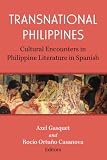
Transnational Philippines : cultural encounters in Philippine literature in Spanish / edited by Axel Gasquet and Rocio Ortuño Casanova.
Contributor(s): Gasquet, Axel [editor.] | Ortuño Casanova, Rocío [editor.] | Michigan Publishing (University of Michigan) [publisher.]
Language: English Publisher: Ann Arbor, Michigan : University of Michigan Press, [2024]Copyright date: ©2024Description: 1 online resource (vi, 295 pages) : illustrationsContent type: text Media type: computer Carrier type: online resourseISBN: 9780472133505; 0472133500; 9780472039616; 047203961XOther title: Cultural encounters in Philippine literature in SpanishSubject(s): Philippine literature (Spanish) -- History and criticism | Postcolonialism in literature | Postcolonialism -- Philippines | Littérature philippine (espagnole) -- Histoire et critique | Postcolonialisme dans la littérature | Postcolonialisme -- PhilippinesGenre/Form: Literary criticism. | Essays. | Critiques littéraires.DDC classification: 860.9/9599 LOC classification: PQ8718 | .T73 2024Online resources: Full text is available at the Directory of Open Access Books. Click here to view. Abstract: Transnational Philippines: Cultural Encounters in Philippine Literature in Spanish approaches literature that has been forgotten or neglected in studies on other literatures in Spanish due, in part, to the fact that today Spanish is no longer spoken in the Philippines or in Asia. However, isolation has not always been the case, and by omitting Philippine literature in Spanish from the picture of world literatures and Spanish-language literatures, the landscape of these disciplines is incomplete. Transnational Philippines studies how this literary production stemmed from its relationship with other cultures, literature, and arts. It attempts to break this literature's isolation and show how it is part of the broad literary system of literature written in Spanish. Yet Transnational Philippines also questions the constraints of traditional literary genres in order to make room for Philippine texts and other colonial and postcolonial texts, so that those texts can be taken into consideration in literary studies. Its chapters elaborate on the problems surrounding the cultural and identity relations of the Philippines with other regions and the literary nature of Philippine texts. By addressing the need for a postnational approach to Spanish-language Philippine literature, the book challenges the Spain/Latin America dichotomy existing in Spanish language literary studies and leans toward a global conception of the Hispanophone.| Item type | Current location | Home library | Call number | Status | Date due | Barcode | Item holds |
|---|---|---|---|---|---|---|---|
 EBOOK/OPEN ACCESS
|
COLLEGE LIBRARY | COLLEGE LIBRARY | 860.9/9599 (Browse shelf) | Not for loan |
Browsing COLLEGE LIBRARY Shelves Close shelf browser

|
No cover image available |

|

|

|
No cover image available | No cover image available | ||
| 849/.933 M867 1996 Tirant lo Blanc / | 860 Sa58f 1924 Flora: la educacion de una niña/ | 860.355 W459 2000 Persephone's girdle : narratives of rape in seventeenth-century Spanish literature / | 860.9/9599 Transnational Philippines : cultural encounters in Philippine literature in Spanish / | 860.9 V426 2008 Wellsprings / | 860.9006 Si64 1968 Celestina : a play in twenty-one acts attributed to Fernando de Rojas / | 860.997 P537d 1964 Philippines (Republic) educacion, Departmente de DiScursos de Malolos y poesias Filipinas en Español/ |
Includes bibliographical references and index.
Transnational Philippines: Cultural Encounters in Philippine Literature in Spanish approaches literature that has been forgotten or neglected in studies on other literatures in Spanish due, in part, to the fact that today Spanish is no longer spoken in the Philippines or in Asia. However, isolation has not always been the case, and by omitting Philippine literature in Spanish from the picture of world literatures and Spanish-language literatures, the landscape of these disciplines is incomplete. Transnational Philippines studies how this literary production stemmed from its relationship with other cultures, literature, and arts. It attempts to break this literature's isolation and show how it is part of the broad literary system of literature written in Spanish. Yet Transnational Philippines also questions the constraints of traditional literary genres in order to make room for Philippine texts and other colonial and postcolonial texts, so that those texts can be taken into consideration in literary studies. Its chapters elaborate on the problems surrounding the cultural and identity relations of the Philippines with other regions and the literary nature of Philippine texts. By addressing the need for a postnational approach to Spanish-language Philippine literature, the book challenges the Spain/Latin America dichotomy existing in Spanish language literary studies and leans toward a global conception of the Hispanophone.
There are no comments for this item.