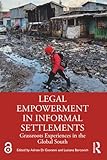
Legal empowerment in informal settlements : grassroots experiences in the Global South / Adrian di Giovanni, Luciana Bercovich.
Contributor(s): Di Giovanni, Adrian [editor.] | Bercovich, Luciana [editor.]
Language: English Publisher: New York, NY : Routledge, 2025Description: 1 online resourceContent type: text Media type: computer Carrier type: online resourceISBN: 9781032886282; 1003538800; 1040343368; 9781040343340; 1040343341; 9781040343364Subject(s): Legal assistance to the poor -- Africa | Legal assistance to the poor -- Asia | Legal assistance to the poor -- Latin America | Urban poor -- Africa -- Service for | Urban poor -- Asia -- Service for | Urban poor -- Latin America -- Service for | Squatter settlements -- Government policy -- Africa | Squatter settlements -- Government policy -- Asia | Squatter settlements -- Government policy -- Latin America | Aide juridique aux pauvres -- Afrique | Aide juridique aux pauvres -- AsieGenre/Form: Electronic books.DDC classification: 362.58 LOC classification: K133Online resources: Full text is available at the Directory of Open Access Books. Click here to view Summary: "This book investigates grassroots, community-led justice strategies - known as legal empowerment - being used to promote the human rights of people living in informal settlements in the Global South. Residents of informal settlements, also known as slums or favelas, encounter a complex array of human rights violations; from systemic discrimination by public officials, to threats to physical security from forced evictions, or arbitrary arrests, to a lack of access to basic services such as housing, water, sanitation, and education. This book shows how grassroots justice organizations around the world are working with residents to defend their rights and secure more dignified living conditions. Drawing on original empirical research across 10 countries in Africa, Asia, and Latin America, the book demonstrates how legal empowerment can put residents at the centre of holistic approaches to urban development and confront exclusionary and undemocratic systems of governance. The book encompasses practical recommendations and strategies such as rights-based approaches to informality, participation, community mobilization and litigation. Bridging the gaps between the law on the books and the harsh realities of informality on the ground, this book will be an important read for researchers, practitioners, and policymakers, working in realms of social and economic rights, access to justice and urban poverty and development"-- Provided by publisher.| Item type | Current location | Home library | Call number | Status | Date due | Barcode | Item holds |
|---|---|---|---|---|---|---|---|
 EBOOK/OPEN ACCESS
|
COLLEGE LIBRARY | COLLEGE LIBRARY | 362.58 L5224 2025 (Browse shelf) | Not for loan |
Browsing COLLEGE LIBRARY Shelves Close shelf browser

|
No cover image available | No cover image available |

|

|

|
|
||
| 362.5599 P258 2003 Participatory governance in poverty alleviation / | 362.58 D361 2002 Defining an agenda for poverty reduction: proceedings of the First Asia and Pacific Forum on Poverty/ | 362.58 D361 2002 Defining an agenda for poverty reduction: proceedings of the First Asia and Pacific Forum on Poverty/ | 362.58 L5224 2025 Legal empowerment in informal settlements : grassroots experiences in the Global South / | 362.58091724 V285 1996 Policy programme options for urban poverty reduction : a framework for action at the municipal level / | 362.580951 C441 2001 China : overcoming rural poverty / | 362.580951 C441 2001 China : overcoming rural poverty / |
Includes bibliographical references and index.
"This book investigates grassroots, community-led justice strategies - known as legal empowerment - being used to promote the human rights of people living in informal settlements in the Global South. Residents of informal settlements, also known as slums or favelas, encounter a complex array of human rights violations; from systemic discrimination by public officials, to threats to physical security from forced evictions, or arbitrary arrests, to a lack of access to basic services such as housing, water, sanitation, and education. This book shows how grassroots justice organizations around the world are working with residents to defend their rights and secure more dignified living conditions. Drawing on original empirical research across 10 countries in Africa, Asia, and Latin America, the book demonstrates how legal empowerment can put residents at the centre of holistic approaches to urban development and confront exclusionary and undemocratic systems of governance. The book encompasses practical recommendations and strategies such as rights-based approaches to informality, participation, community mobilization and litigation. Bridging the gaps between the law on the books and the harsh realities of informality on the ground, this book will be an important read for researchers, practitioners, and policymakers, working in realms of social and economic rights, access to justice and urban poverty and development"-- Provided by publisher.
Creative Commons Attribution-NoDerivatives 4.0 International CC BY-ND 4.0
https://creativecommons.org/licenses/by-nd/4.0/
Description based on print version record and CIP data provided by publisher; resource not viewed.
There are no comments for this item.