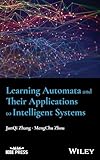
Learning automata and their applications to intelligent systems / JunQi Zhang, MengChu Zhou.
By: Zhang, JunQi (Professor) [author.]
Contributor(s): Zhou, MengChu [author.]
Language: English Publisher: Hoboken, New Jersey : John Wiley & Sons, Inc., [2024]Description: 1 online resource (xvii, 251 pages) : illustrations (chiefly color)Content type: text Media type: computer Carrier type: online resourceISBN: 9781394188499 ; 9781394188536; 1394188536; 9781394188529; 1394188528; 9781394188505; 1394188501Subject(s): Machine theoryGenre/Form: Electronic books.DDC classification: 629.8/92631 LOC classification: QA267 | .Z43 2024Online resources: Full text is available at Wiley Online Library Click here to view Summary: "A learning automaton represents an important and powerful tool in the area of reinforcement learning and aims at learning the optimal one that maximizes the probability of being rewarded out of a set of allowable systems, actions, alternatives, candidates, or designs by the interaction with a random environment. During a cycle, an automaton chooses an action and then receives a stochastic response that can be either a reward or penalty from the environment. The action probability vector of choosing the next action is then updated by employing this response. The ability of learning how to choose the optimal action endows learning automata with high adaptability to the environment, thus saving great expense and time to find the optimal one in various difficult stochastic environments."-- Provided by publisher.| Item type | Current location | Home library | Call number | Status | Date due | Barcode | Item holds |
|---|---|---|---|---|---|---|---|
 EBOOK
EBOOK
|
COLLEGE LIBRARY | COLLEGE LIBRARY | 629.892631 Z612 2023 (Browse shelf) | Available |
Includes bibliographical references and index.
"A learning automaton represents an important and powerful tool in the area of reinforcement learning and aims at learning the optimal one that maximizes the probability of being rewarded out of a set of allowable systems, actions, alternatives, candidates, or designs by the interaction with a random environment. During a cycle, an automaton chooses an action and then receives a stochastic response that can be either a reward or penalty from the environment. The action probability vector of choosing the next action is then updated by employing this response. The ability of learning how to choose the optimal action endows learning automata with high adaptability to the environment, thus saving great expense and time to find the optimal one in various difficult stochastic environments."-- Provided by publisher.
About the Author
JunQi Zhang, PhD, is a Full Professor with Tongji University in Shanghai. He has published 10+ papers in IEEE Transactions and 30+ papers in conferences. His current research interests include learning automata, swarm intelligence, swarm robots, multi-agent systems, reinforcement learning, and big data.
MengChu Zhou, PhD, is a Distinguished Professor at New Jersey Institute of Technology. He has over 1100 publications including 14 books, 750+ journal papers (600+ in IEEE transactions), 31 patents, and 32 book-chapters. He is Fellow of IEEE, IFAC, AAAS, CAA and NAI.
There are no comments for this item.