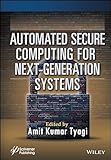
Automated secure computing for next-generation systems / edited by Amit Kumar Tyagi.
Contributor(s): Tyagi, Amit Kumar [editor.]
Language: English Publisher: Hoboken, NJ : Wiley, 2024Description: 1 online resource (468 pages)Content type: text Media type: computer Carrier type: online resourceISBN: 9781394213597 ; 9781394213924; 1394213921; 9781394213948; 1394213948Subject(s): Computer securityGenre/Form: Electronic books.DDC classification: 005.8 LOC classification: QA76.9.A25Online resources: Full text is available at Wiley Online Library Click here to view Summary: Security is always a primary concern for each application and sector. In the last decade, many techniques and frameworks have been suggested to improve security (data, information, and network). Due to rapid improvements in industry automation, however, systems need to be secured more quickly and efficiently. It is important to explore the best ways to incorporate the suggested solutions to improve their accuracy while reducing their learning cost. During implementation, the most difficult challenge is determining how to exploit AI and ML algorithms for improved safe service computation while maintaining the user's privacy. The robustness of AI and deep learning, as well as the reliability and privacy of data, is an important part of modern computing. It is essential to determine the security issues of using AI to protect systems or ML-based automated intelligent systems. To enforce them in reality, privacy would have to be maintained throughout the implementation process. This book presents groundbreaking applications related to artificial intelligence and machine learning for more stable and privacy-focused computing. By reflecting on the role of machine learning in information, cyber, and data security, Automated Secure Computing for Next-Generation Systems outlines recent developments in the security domain with artificial intelligence, machine learning, and privacy-preserving methods and strategies. To make computation more secure and confidential, the book provides ways to experiment, conceptualize, and theorize about issues that include AI and machine learning for improved security and preserve privacy in next-generation-based automated and intelligent systems. Hence, this book provides a detailed description of the role of AI, ML, etc., in automated and intelligent systems used for solving critical issues in various sectors of modern society.| Item type | Current location | Home library | Call number | Status | Date due | Barcode | Item holds |
|---|---|---|---|---|---|---|---|
 EBOOK
EBOOK
|
COLLEGE LIBRARY | COLLEGE LIBRARY | 005.8 Au823 2023 (Browse shelf) | Available |
Browsing COLLEGE LIBRARY Shelves Close shelf browser

|

|

|

|

|

|

|
||
| 005.8 An244 2020 Security engineering : a guide to building dependable distributed systems / | 005.8 An257 2017 Coding for penetration testers : building better tools / | 005.8 An829 2020 Applied incident response / | 005.8 Au823 2023 Automated secure computing for next-generation systems / | 005.8 B21 2009 Securing PHP web applications / | 005.8 B215 2015 Ethical hacking and penetration testing guide / | 005.8 B345 2024 Stepping through cybersecurity risk management : a systems thinking approach / |
Description based upon print version of record.
Security is always a primary concern for each application and sector. In the last decade, many techniques and frameworks have been suggested to improve security (data, information, and network). Due to rapid improvements in industry automation, however, systems need to be secured more quickly and efficiently. It is important to explore the best ways to incorporate the suggested solutions to improve their accuracy while reducing their learning cost. During implementation, the most difficult challenge is determining how to exploit AI and ML algorithms for improved safe service computation while maintaining the user's privacy. The robustness of AI and deep learning, as well as the reliability and privacy of data, is an important part of modern computing. It is essential to determine the security issues of using AI to protect systems or ML-based automated intelligent systems. To enforce them in reality, privacy would have to be maintained throughout the implementation process. This book presents groundbreaking applications related to artificial intelligence and machine learning for more stable and privacy-focused computing. By reflecting on the role of machine learning in information, cyber, and data security, Automated Secure Computing for Next-Generation Systems outlines recent developments in the security domain with artificial intelligence, machine learning, and privacy-preserving methods and strategies. To make computation more secure and confidential, the book provides ways to experiment, conceptualize, and theorize about issues that include AI and machine learning for improved security and preserve privacy in next-generation-based automated and intelligent systems. Hence, this book provides a detailed description of the role of AI, ML, etc., in automated and intelligent systems used for solving critical issues in various sectors of modern society.
About the Author
Amit Kumar Tyagi, PhD, is an assistant professor, at the National Institute of Fashion Technology, New Delhi, India. He has published more than 100 papers in refereed international journals, conferences, and books. He has filed more than 20 national and international patents in the areas of deep learning, Internet of Things, cyber-physical systems, and computer vision. His current research focuses on smart and secure computing and privacy, amongst other interests.
There are no comments for this item.