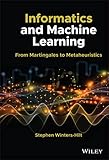
Informatics and machine learning : from Martingales to metaheuristics / Stephen Winters-Hilt.
By: Winters-Hilt, Stephen [author.]
Language: English Publisher: Hoboken, NJ : John Wiley & Sons, Inc., 2022Copyright date: ©2022Description: 1 online resource (xv, 566 pages) : illustrationsContent type: text Media type: computer Carrier type: online resourceISBN: 9781119716747 ; 9781119716730; 111971673X; 9781119716570; 1119716578; 9781119716761; 1119716764Subject(s): Machine learning | Computer science | BioinformaticsGenre/Form: Electronic books.DDC classification: 006.3/1 LOC classification: Q325.5 | .W558 2022Online resources: Full text is available at Wiley Online Library Click here to view Summary: "This book provides an interdisciplinary presentation on machine learning, bioinformatics and statistics. This book is an accumulation of lecture notes and interesting research tidbits from over two decades of the author's teaching experience. The chapters in this book can be traversed in different ways for different course offerings. In the classroom, the trend is moving towards hands-on work with running code. Therefore, the author provides lots of sample code to explicitly explain and provide example-based code for various levels of project work. This book is especially useful for professionals entering the rapidly growing Machine Learning field due to its complete presentation of the mathematical underpinnings and extensive examples of programming implementations. Many Machine Learning (ML) textbooks miss a strong intro/basis in terms of information theory. Using mutual information alone, for example, a genome's encoding scheme can be 'cracked' with less than one page of Python code. On the implementation side, many ML professional/reference texts often do not shown how to actually access raw data files and reformat the data into some more usable form. Methods and implementations to do this are described in the proposed text, where most code examples are in Python (some in C/C++, Perl, and Java, as well). Once the data is in hand all sorts of fun analytics and advanced machine learning tools can be brought to bear."-- Provided by publisher.| Item type | Current location | Home library | Call number | Status | Date due | Barcode | Item holds |
|---|---|---|---|---|---|---|---|
 EBOOK
EBOOK
|
COLLEGE LIBRARY | COLLEGE LIBRARY | 006.31 W736 2021 (Browse shelf) | Available |
Includes bibliographical references and index.
"This book provides an interdisciplinary presentation on machine learning, bioinformatics and statistics. This book is an accumulation of lecture notes and interesting research tidbits from over two decades of the author's teaching experience. The chapters in this book can be traversed in different ways for different course offerings. In the classroom, the trend is moving towards hands-on work with running code. Therefore, the author provides lots of sample code to explicitly explain and provide example-based code for various levels of project work. This book is especially useful for professionals entering the rapidly growing Machine Learning field due to its complete presentation of the mathematical underpinnings and extensive examples of programming implementations. Many Machine Learning (ML) textbooks miss a strong intro/basis in terms of information theory. Using mutual information alone, for example, a genome's encoding scheme can be 'cracked' with less than one page of Python code. On the implementation side, many ML professional/reference texts often do not shown how to actually access raw data files and reformat the data into some more usable form. Methods and implementations to do this are described in the proposed text, where most code examples are in Python (some in C/C++, Perl, and Java, as well). Once the data is in hand all sorts of fun analytics and advanced machine learning tools can be brought to bear."-- Provided by publisher.
About the Author
Stephen Winters-Hilt, PhD, is Sole Proprietor at Meta Logos Systems, Albuquerque, NM, USA, which specializes in Machine Learning, Signal Analysis, Financial Analytics, and Bioinformatics. He received his doctorate in Theoretical Physics from the University of Wisconsin, as well as a PhD in Computer Science and Bioinformatics from the University of California, Santa Cruz.
There are no comments for this item.