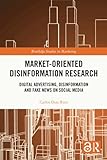
Market-oriented disinformation research : digital advertising, disinformation and fake news on social media / Carlos Diaz Ruiz.
By: Diaz Ruiz, Carlos [author]
Language: English Series: Routledge studies in marketingPublisher: Abingdon, Oxon ; New York, NY : Routledge, 2025Description: 1 online resourceContent type: text Media type: computer Carrier type: online resourceISBN: 9781032828541; 9781032828558Subject(s): Disinformation -- Research | Consumers -- Research | Social media -- Political aspectsGenre/Form: Electronic books.DDC classification: 303.3/75 LOC classification: HM1231 | .D53 2025Online resources: Full text is available at Directory of Open Access Books. Click here to view. Summary: "Market-Oriented Disinformation Research explores the spread of false or misleading information online through the lens of marketing theory and consumer research. It examines how the business models of digital platforms and advertising technology firms (AdTech) generate digital markets that incentivize the circulation of harmful content for profit. Rather than viewing disinformation and misinformation as accidental byproducts, the book proposes that they thrive in the current markets designed for digital advertising and influencer marketing. Readers will learn how the amplification of disinformation can be linked to social media's business model. Examples include how social media algorithms promote addictive content, how fake news sites use ad fraud to lure in advertising revenue, and how some content creators rely on clickbait, ragebait, bots, and conspiracy theories to boost their engagement metrics. The book is a must-read for scholars in journalism, media studies, and political communication, as well as policymakers interested in the democratic governance of social media platforms. In addition, it calls for digital marketing, advertising, and brand management professionals to take responsibility for their ad spending by advocating for greater oversight over AdTech intermediaries to prevent unethical actors from monetizing the harmful content that polarizes society and undermines democratic institutions"-- Provided by publisher.| Item type | Current location | Home library | Call number | Status | Date due | Barcode | Item holds |
|---|---|---|---|---|---|---|---|
 EBOOK
EBOOK
|
COLLEGE LIBRARY | COLLEGE LIBRARY | 303.375 D5439 2025 (Browse shelf) | Available |
Browsing COLLEGE LIBRARY Shelves Close shelf browser

|

|

|

|

|

|

|
||
| 303.372599 R33 2007 Values : stories for Filipino children / | 303.372599 T481 2003 Filipino values today / | 303.37259907 Q48 1996 Values education through history: peace & tolerance/ | 303.375 D5439 2025 Market-oriented disinformation research : digital advertising, disinformation and fake news on social media / | 303.380973 G562 1997 Where America stands 1997 / | 303.380973 N4201 2016 New directions in public opinion / | 303.385 M5833 2019 Microaggression theory : influence and implications / |
Includes bibliographical references and index.
"Market-Oriented Disinformation Research explores the spread of false or misleading information online through the lens of marketing theory and consumer research. It examines how the business models of digital platforms and advertising technology firms (AdTech) generate digital markets that incentivize the circulation of harmful content for profit. Rather than viewing disinformation and misinformation as accidental byproducts, the book proposes that they thrive in the current markets designed for digital advertising and influencer marketing. Readers will learn how the amplification of disinformation can be linked to social media's business model. Examples include how social media algorithms promote addictive content, how fake news sites use ad fraud to lure in advertising revenue, and how some content creators rely on clickbait, ragebait, bots, and conspiracy theories to boost their engagement metrics. The book is a must-read for scholars in journalism, media studies, and political communication, as well as policymakers interested in the democratic governance of social media platforms. In addition, it calls for digital marketing, advertising, and brand management professionals to take responsibility for their ad spending by advocating for greater oversight over AdTech intermediaries to prevent unethical actors from monetizing the harmful content that polarizes society and undermines democratic institutions"-- Provided by publisher.
There are no comments for this item.