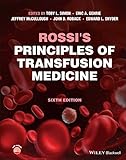
Rossi's principles of transfusion medicine / edited by Toby L. Simon, Eric A. Gehrie, Jeffrey McCullough, John D. Roback, Edward L. Snyder.
Contributor(s): Simon, Toby L [editor.] | Gehrie, Eric A [editor.] | McCullough, Jeffrey [editor.] | Roback, John D [editor.] | Snyder, Edward L. (Edward Leonard) [editor.]
Language: English Publisher: Hoboken, NJ : John Wiley & Sons, Inc., 2022Copyright date: ©2022Edition: Sixth editionDescription: 1 online resource (xxii, 708 pages) : illustrations (chiefly color)Content type: text Media type: computer Carrier type: online resourceISBN: 9781119719755 ; 9781119719793; 1119719798; 9781119719809; 1119719801; 9781119719786; 111971978XOther title: Principles of transfusion medicineSubject(s): Blood -- Transfusion | Blood cells | Blood Transfusion | Blood Cells | Blood Grouping and Crossmatching | Transfusion ReactionGenre/Form: Electronic books.DDC classification: 615.3/9 LOC classification: RM171 | .P75 2022Online resources: Full text is available at Wiley Online Library Click here to view Summary: "Prehistoric man left drawings of himself pierced by arrows.1 This means he was as aware of blood as he was of his own limbs. The flint implements he used as tools and weapons distinguished him from other creatures and contributed to the violence of his era. As he hunted food and fought enemies, he observed bleeding and the properties of blood. A cut, received or inflicted, yielded a vivid red color. If the cut was shallow, there was little blood. But if the cut was deep, a red torrent flowing from the stricken victim quickly led to death, with shed blood congealed and darkening in the sun. Fatal hemorrhage was commonplace. Nonetheless, the sight must have been fearful and possibly existential as life flowed red out of the body of an enemy or a wounded animal. 2 It is no wonder, then, that at the dawn of recorded history, blood was already celebrated in religious rites and rituals as a life-giving force"-- Provided by publisher.| Item type | Current location | Home library | Call number | Status | Date due | Barcode | Item holds |
|---|---|---|---|---|---|---|---|
 EBOOK
EBOOK
|
COLLEGE LIBRARY | COLLEGE LIBRARY | 615.39 R736 2022 (Browse shelf) | Available |
Includes bibliographical references and index.
"Prehistoric man left drawings of himself pierced by arrows.1 This means he was as aware of blood as he was of his own limbs. The flint implements he used as tools and weapons distinguished him from other creatures and contributed to the violence of his era. As he hunted food and fought enemies, he observed bleeding and the properties of blood. A cut, received or inflicted, yielded a vivid red color. If the cut was shallow, there was little blood. But if the cut was deep, a red torrent flowing from the stricken victim quickly led to death, with shed blood congealed and darkening in the sun. Fatal hemorrhage was commonplace. Nonetheless, the sight must have been fearful and possibly existential as life flowed red out of the body of an enemy or a wounded animal. 2 It is no wonder, then, that at the dawn of recorded history, blood was already celebrated in religious rites and rituals as a life-giving force"-- Provided by publisher.
There are no comments for this item.